¶ Introduction
In display technology, Pixel Clock and AV Interface Bandwidth are two critical parameters that determine whether a specific resolution and refresh rate can be supported by a given hardware setup. This guide integrates key formulas and interface specifications to help engineers validate compatibility between display resolutions and video interfaces (e.g., HDMI, DisplayPort).
¶ Core Concepts
¶ Core Formulas for Pixel Clock Conversion
The Pixel Clock is the frequency required to transmit all pixels of a resolution within one second. It depends on three factors:
- Total Horizontal Pixels = Active Pixels + Horizontal Blanking
- Total Vertical Lines = Active Lines + Vertical Blanking
- Refresh Rate = Frames per second (Hz)
¶ Pixel Clock Calculation by Color Format
| Bit Depth | RGB444 | YUV444 | YUV422 (HDMI) | YUV422 (DP) | YUV420 |
|---|---|---|---|---|---|
| 8-bit |
Pixel_Clk_444_8bit = Pixel_Clk |
Pixel_Clk_444_8bit = Pixel_Clk |
Pixel_Clk_422_8bit = Pixel_Clk × ⅔ |
Pixel_Clk_422_8bit = Pixel_Clk × ½ |
Pixel_Clk_420_8bit = Pixel_Clk × ½ |
| 10-bit |
Pixel_Clk_444_10bit = Pixel_Clk × 10/8 |
Pixel_Clk_444_10bit = Pixel_Clk × 10/8 |
Pixel_Clk_422_10bit = (Pixel_Clk × 10/8) × ⅔ |
Pixel_Clk_422_10bit = (Pixel_Clk × 10/8) × ½ |
Pixel_Clk_420_10bit = (Pixel_Clk × 10/8) × ½ |
| 12-bit |
Pixel_Clk_444_12bit = Pixel_Clk × 12/8 |
Pixel_Clk_444_12bit = Pixel_Clk × 12/8 |
Pixel_Clk_422_12bit = (Pixel_Clk × 12/8) × ⅔ |
Pixel_Clk_422_12bit = (Pixel_Clk × 12/8) × ½ |
Pixel_Clk_420_12bit = (Pixel_Clk × 12/8) × ½ |
¶ Interface Bandwidth and Resolution Limits
| Interface | Max Bandwidth | 8-bit Resolution | 10-bit Resolution | 12-bit Resolution | Max Pixels (M) |
|---|---|---|---|---|---|
| HDMI 1.0/1.2/1.3 | 4.95 Gbps | 1920×1080@60Hz | 1920×1080@50Hz | 1920×1080@30Hz | 165 |
| HDMI 1.4 | 10.2 Gbps | 1920×1080@120Hz | 1920×1080@100Hz | 1920×1080@60Hz | 340 |
| HDMI 2.0 | 18 Gbps | 4096×2160@50Hz | 4096×2160@50Hz | 1920×1080@144Hz | 600 |
| HDMI 2.1 | 48 Gbps | 10240×4320@30Hz | 8192×4320@30Hz | 8192×4320@30Hz | 1777 |
| DP 1.2 | 21.6 Gbps | 4096×2160@60Hz | 4096×2160@60Hz | 4096×2160@50Hz | 720 |
| DP 1.4 | 32.4 Gbps | 7680×4320@30Hz | 5120×2160@60Hz | 5120×2160@60Hz | 1080 |
| DP 2.0 | 80 Gbps | 8192×4320@60Hz | 8192×4320@60Hz | 8192×4320@50Hz | 3232 |
Note:
*Red text indicates resolutions requiring reduced refresh rates.
¶ DSC
Display Stream Compression (DSC) is a visually lossless compression standard developed by the Video Electronics Standards Association (VESA), specifically designed to address the challenges of transmitting high-resolution video streams, including 4K/8K ultra-high-definition (UHD) content, high refresh rates (e.g., 120Hz/144Hz), and HDR (High Dynamic Range) signals. Since its initial release in 2014, DSC has become a cornerstone technology for modern display interfaces.
¶ Technical Principles
DSC employs a hybrid compression algorithm that integrates predictive coding, color space conversion, quantization, and entropy coding. Its primary goal is to reduce video bandwidth to one-third of the original data while maintaining "visually lossless" quality (i.e., imperceptible differences to the human eye). The process involves dividing images into pixel blocks, analyzing spatial redundancies through predictive models, and applying adaptive quantization to minimize data volume. Further compression is achieved via advanced entropy coding techniques, such as Context-Adaptive Binary Arithmetic Coding (CABAC).
¶ Key Advantages
- Visually Lossless Quality: Rigorously tested by VESA (e.g., double-blind trials), DSC maintains near-identical visual fidelity to uncompressed content even at a 3:1 compression ratio, making it ideal for color-critical applications like professional graphic design and medical imaging.
- Ultra-Low Latency: With encoding/decoding delays typically shorter than one pixel line time, DSC supports real-time interactions in high-refresh-rate gaming monitors and VR headsets.
- Broad Compatibility: DSC is natively supported by major interface standards, including HDMI 2.1, DisplayPort 1.4/2.1, USB4, and MIPI DSI-2, enabling seamless integration across smartphones, tablets, TVs, and automotive displays.
- Energy and Cost Efficiency: By reducing bandwidth requirements, DSC minimizes reliance on expensive high-speed cables and processors. For example, an 8K@60Hz signal, which originally demands 48Gbps bandwidth, can be compressed to 18Gbps using DSC, fully compatible with existing DisplayPort 1.4 infrastructure.
¶ Calculation Workflow
¶ Example 1: HDMI 2.0 with 4096×2160@50Hz (12-bit YUV422)
- Calculate Base Pixel Clock:
Total Pixels = (4096 + 160) × (2160 + 45) = 4256 × 2205 = 9,380,880
Pixel Clock = 9,380,880 × 50 Hz ≈ 469.04 MHz
- Adjust for YUV422 (HDMI) and 12-bit:
Adjusted Pixel Clock = (469.04 × 12/8) × 2/3 ≈ 469.04 × 1.5 × 0.666 ≈ 469.04 MHz
- Calculate Bandwidth:
Bandwidth = 469.04 × 12 × 2 × 1.2 ≈ 13,550 Mbps = 13.55 Gbps
- Verification:
HDMI 2.0 supports 18 Gbps → Compatible.
¶ Example 2: DP 2.0 Driving 8192×4320@60Hz (8-bit RGB444)
- Calculate Base Pixel Clock:
Total Pixels = (8192 + 160) × (4320 + 45) = 8352 × 4365 = 36,454,680
Pixel Clock = 36,454,680 × 60 Hz ≈ 2,187.28 MHz
- Bandwidth Calculation:
Bandwidth = 2,187.28 × 8 × 3 × 1.2 ≈ 63,360 Mbps = 63.36 Gbps
- Verification:
DP 2.0 supports 80 Gbps → Compatible.
¶ Excel Tool for Interface Quantity Calculation
To simplify the validation process, we provide an Excel-based calculator that automates pixel clock and bandwidth calculations. Users only need to input the following parameters:
- Target Resolution: Active pixels (horizontal × vertical).
- Refresh Rate: Desired frame rate (Hz).
Interface Quantity Calculation Excel_20260717
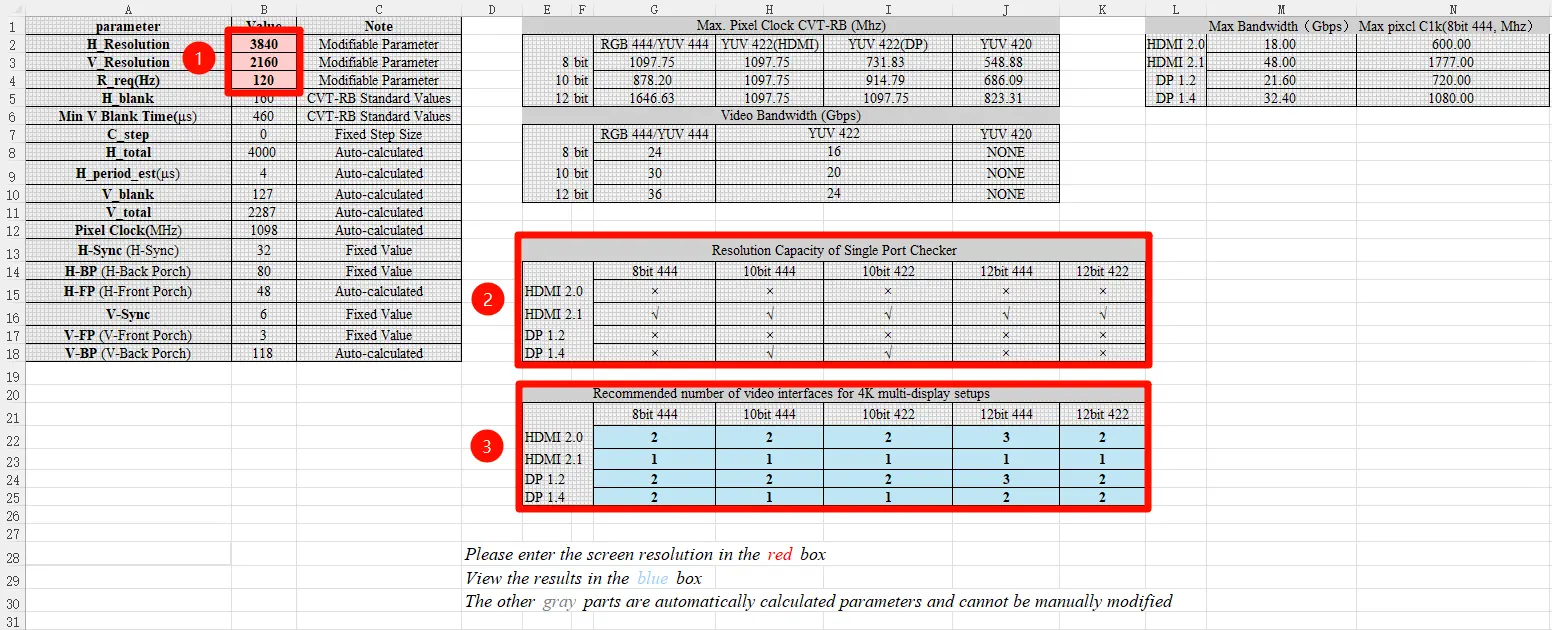
- Fill in the parameters in Position 1, and the table will calculate the pixel clock based on industry-standard formulas.
- The table will automatically compare bandwidth requirements against interface limits and indicate single-interface feasibility in Position 2.
- Position 3 shows the recommended minimum number of required interfaces (e.g., HDMI 2.1 ports or DisplayPort 2.0).
Note:
The calculation results generated by this tool are for reference only.
Always consult your FAE (Field Application Engineer) for final validation before designing hardware or purchasing components.
Validating pixel clocks and interface bandwidths is essential for designing display systems that balance performance, cost, and compatibility. By leveraging standardized formulas and interface specifications, engineers can avoid hardware mismatches and optimize signal integrity.
We consistently enhance and refine the content of our Wiki articles.
If you find any mistakes or errors, please contact us.
Your continuous feedback and support will help us further improve our products and content.