¶ Appearance
¶ Front Panel
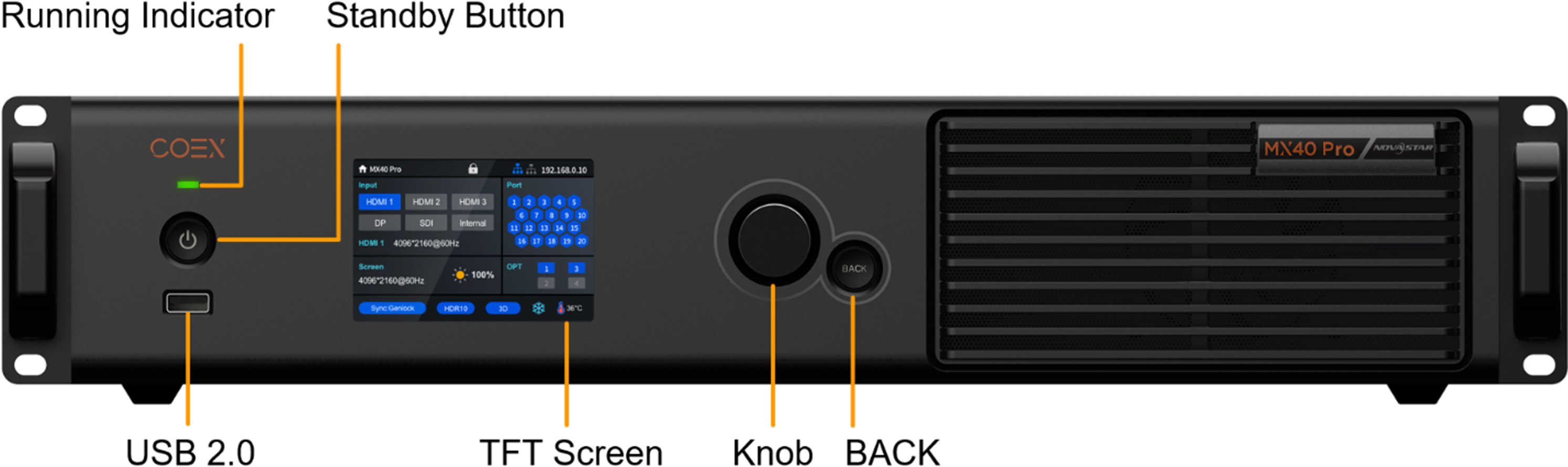
|
Name |
Function |
|---|---|
|
Running indicator |
|
|
Standby button |
|
|
USB 2.0 |
|
|
TFT Screen |
A 3.5-inch screen to display the device status, menus, submenus and messages for parameter settings. |
|
Knob |
|
|
BACK |
Go back to the previous menu or cancel the current operation. |
¶ Rear Panel

|
Type |
Qty |
Description |
|
|---|---|---|---|
|
Inputs |
|||
|
HDMI 2.0-1 IN |
1 |
Resolutions |
Max resolution: 4096×2160@60Hz/8192×1080@60Hz (Forced) Min resolution: 800×600@60Hz |
|
Max width/height (Forced) |
Max width: 8192 pixels (8192×1080@60Hz) Max height: 8192 pixels (1080×8192@60Hz) |
||
|
Frame rates |
23.98/24/25/29.97/30/47.95/48/50/59.94/60/71.93/72/75 /100/119.88/120/143.86/144/240 Hz |
||
|
HDR |
Support HDR10 and comply with the SMPTE ST 2084 and SMPTE ST 2086 standards. Support HLG. |
||
|
EDID management |
Support standard resolutions, up to 3840×2160@60Hz. Support custom input resolutions. |
||
|
HDCP |
HDCP 2.2 compliant, backwards compatible with HDCP 1.4/HDCP 1.3. |
||
|
Interlaced signal inputs |
Not supported. |
||
|
HDMI 2.0-2 IN |
1 |
Resolutions |
Max resolution: 4096×2160@60Hz/8192×1080@60Hz (Forced) Min resolution: 800×600@60Hz |
|
Max width/height (Forced) |
Max width: 8192 pixels (8192×1080@60Hz) Max height: 7680 pixels (1080×7680@60Hz) |
||
|
Frame rates |
23.98/24/25/29.97/30/47.95/48/50/59.94/60/71.93/72/75 /100/119.88/120/143.86/144/240 Hz |
||
|
HDR |
Support HDR10 and comply with the SMPTE ST 2084 and SMPTE ST 2086 standards. Support HLG. |
||
|
EDID management |
Support standard resolutions, up to 3840×2160@60Hz. Support custom input resolutions. |
||
|
HDCP |
HDCP 2.2 compliant, backwards compatible with HDCP 1.4/HDCP 1.3. |
||
|
Interlaced signal inputs |
Not supported. |
||
|
HDMI 2.0-3 IN |
1 |
Resolutions |
Max resolution: 4096×2160@60Hz/8192×1080@60Hz (Forced) Min resolution: 800×600@60Hz |
|
Max width/height (Forced) |
Max width: 8192 pixels (8192×1080@60Hz) Max height: 7680 pixels (1080×7680@60Hz) |
||
|
Frame rates |
23.98/24/25/29.97/30/47.95/48/50/59.94/60/71.93/72/75 /100/119.88/120/143.86/144/240 Hz |
||
|
HDR |
Support HDR10 and comply with the SMPTE ST 2084 and SMPTE ST 2086 standards. Support HLG. |
||
|
EDID management |
Support standard resolutions, up to 3840×2160@60Hz. Support custom input resolutions. |
||
|
HDCP |
HDCP 2.2 compliant, backwards compatible with HDCP 1.4/HDCP 1.3. |
||
|
Interlaced signal inputs |
Not supported. |
||
|
DP 1.2 |
1 |
Resolutions |
Max resolution: 4096×2160@60Hz/8192×1080@60Hz (Forced) Min resolution: 800×600@60Hz |
|
Max width/height (Forced) |
Max width: 8192 pixels (8192×1080@60Hz) Max height: 8192 pixels (1080×8192@60Hz) |
||
|
Frame rates |
23.98/24/25/29.97/30/47.95/48/50/59.94/60/71.93/72/75 /100/119.88/120/143.86/144/240 Hz |
||
|
EDID management |
Support standard resolutions, up to 3840×2160@60Hz. Support custom input resolutions. |
||
|
HDCP |
HDCP 1.3 compliant. |
||
|
Interlaced signal inputs |
Not supported. |
||
|
12G-SDI IN |
1 |
Standards |
Support ST-2082 (12G), ST-2081 (6G), ST-424 (3G) and ST-292 (HD) standard video inputs. Support 3G-Level A. |
|
Resolutions |
Max resolution: 4096×2160@60Hz Min resolution: 720×[email protected] |
||
|
Frame rates |
23.98/24/25/29.97/30/47.95/48/50/59.94/60 Hz |
||
|
Interlaced signal inputs |
Support interlaced signal inputs, including 1080i/576i/480i. |
||
|
Cables |
Recommend using the CANARE-12G SDI coaxial cable. Cables up to 50 meters are supported. |
||
|
Outputs |
|||
|
Type |
Qty |
Description |
|
|
1–20 |
20 |
Gigabit Ethernet output ports. Support hot backup between Ethernet ports.
|
|
|
OPT 1–4 |
4 |
10G optical output ports with a transmission rate of 10.3125 Gbps. Supports setting of output mode. Users may choose between 20-port mode and 40-port mode.

|
|
|
HDMI 2.0-1 LOOP |
1 |
HDMI loop through. Up to 8 devices can be cabled in one loop. |
|
|
HDMI 2.0-2 LOOP |
1 |
||
|
HDMI 2.0-3 LOOP |
1 |
||
|
12G-SDI LOOP |
1 |
SDI loop through. Up to 8 devices can be cabled in one loop. |
|
|
SPDIF OUT |
1 |
A digital audio output. You can select one of the connected input sources (HDMI 2.0_2 or HDMI 2.0_3) for audio output. |
|
|
Controls |
|||
|
Type |
Qty |
Description |
|
|
ETHERNET |
2 |
Gigabit Ethernet control ports. Support TCP/IP protocol and star connection. They have the same functions without priority and order, and can be connected to VMP software and central control devices. No switch or router is needed to deploy multiple devices on the same LAN via device cascading as the network switching function is already built in. Up to 20 MX40 Pro can be cascaded. |
|
|
GENLOCK |
1 |
A pair of Genlock signal connectors. Support Bi-Level, Tri-Level, and Blackburst.
The Genlock input signal supports a frame rate range from 23.98 Hz to 60 Hz. For standard Genlock signal generators, up to 20 MX40 Pro can be cascaded. |
|
|
AUX |
1 |
An auxiliary connector for connecting to central control devices (RS232). |
|
|
Power |
|||
|
100-240V~, 50/60Hz |
1 |
An AC power input connector and switch |
|
Note:
The maximum input resolution and maximum width and height of HDMI and DP connectors must be obtained by setting the graphics card.
¶ Dimensions
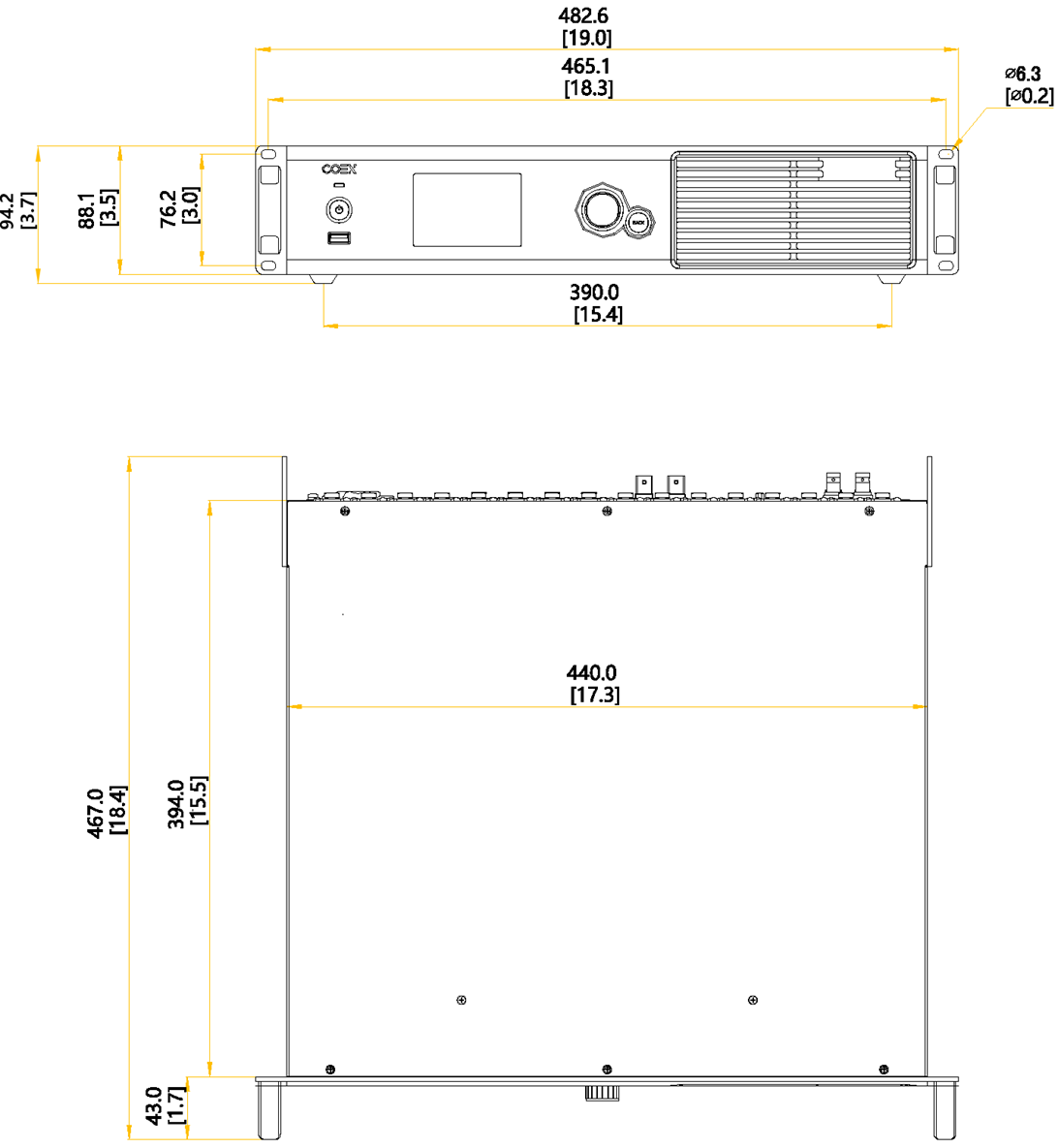
Tolerance: ±0.3 [±0.012] Unit: mm [inch]
¶ Product Specifications
|
Electrical Specifications |
Power input |
100-240V~, 50/60Hz |
|
Max power consumption |
95 W |
|
|
Operating Environment |
Temperature |
–20ºC to +45ºC |
|
Humidity |
0% RH to 80% RH, non-condensing |
|
|
Storage Environment |
Temperature |
–30ºC to +80ºC |
|
Humidity |
0% RH to 95% RH, non-condensing |
|
|
Physical Specifications |
Dimensions |
482.6 mm × 94.2 mm × 467.0 mm (foot pad included) |
|
Net weight |
7.5 kg |
|
|
Gross weight |
10.5 kg Note: It is the total weight of the product, accessories, and packing materials packed according to the packing specifications. |
|
|
Packing Information |
Packing box |
595.0 mm × 575.0 mm × 215.0 mm, kraft paper box |
|
Accessory box |
408.0 mm × 294.0 mm × 51.0 mm, white cardboard box |
|
|
Accessories |
|
|
|
IP Rating |
IP20 (Please prevent the product from water intrusion and do not wet or wash the product). |
|
|
Noise Level (typical at 25°C/77°F) |
38.5 dB (A) |
|
The amount of power consumption may vary depending on various factors such as product settings, usage, and environment.
¶ Video Source Specifications
|
Input |
Resolution |
Color Space |
Sampling |
Bit Depth |
Integer Frame Rate (Hz) |
|
|---|---|---|---|---|---|---|
|
HDMI 2.0 |
4K |
4096×2160 (Forced) |
RGB / YCbCr |
4:4:4 |
12bit |
24/25/30 |
|
10bit |
24/25/30/48/50 |
|||||
|
8bit |
24/25/30/48/50/60 |
|||||
|
YCbCr |
4:2:2 |
8/10/12bit |
||||
|
4:2:0 |
8/10/12bit |
30/48/50/60 |
||||
|
3840×2160 |
RGB / YCbCr |
4:4:4 |
12bit |
24/25/30 |
||
|
10bit |
24/25/30/48/50 |
|||||
|
8bit |
24/25/30/48/50/60 |
|||||
|
YCbCr |
4:2:2 |
8/10/12bit |
||||
|
4:2:0 |
8/10/12bit |
48/50/60 |
||||
|
2K1K |
2560×1440 |
RGB / YCbCr |
4:4:4 |
12bit |
24/25/30/48/50/60/75 |
|
|
10bit |
24/25/30/48/50/60/75/100 |
|||||
|
8bit |
24/25/30/48/50/60/75/100/120 |
|||||
|
YCbCr |
4:2:2 |
8/10/12bit |
||||
|
4:2:0 |
8/10/12bit |
75/100/120 |
||||
|
1920×1080 |
RGB / YCbCr |
4:4:4 |
12bit |
24/25/30/48/50/60/72/75/100/120/144 |
||
|
10bit |
||||||
|
8bit |
24/25/30/48/50/60/72/75/100/120/144/240 |
|||||
|
YCbCr |
4:2:2 |
8/10/12bit |
||||
|
4:2:0 |
8/10/12bit |
120/144/240 |
||||
|
DP 1.2 |
4K |
4096×2160 (Forced) |
RGB / YCbCr |
4:4:4 |
12bit |
24/25/30/48/50 |
|
10bit |
24/25/30/48/50/60 |
|||||
|
8bit |
24/25/30/48/50/60/75 |
|||||
|
YCbCr |
4:2:2 |
8/10/12bit |
||||
|
3840×2160 |
RGB / YCbCr |
4:4:4 |
12bit |
24/25/30/48/50 |
||
|
10bit |
24/25/30/48/50/60 |
|||||
|
8bit |
24/25/30/48/50/60/75 (75 Hz needs to be forced) |
|||||
|
YCbCr |
4:2:2 |
8/10/12bit |
||||
|
2K1K |
2560×1440 |
RGB / YCbCr |
4:4:4 |
12bit |
24/25/30/48/50/60/75/100 |
|
|
10bit |
24/25/30/48/50/60/75/100/120 |
|||||
|
8bit |
24/25/30/48/50/60/75/100/120/144 (144 Hz needs to be forced) |
|||||
|
YCbCr |
4:2:2 |
8/10/12bit |
||||
|
1920×1080 |
RGB / YCbCr |
4:4:4 |
12bit |
24/25/30/48/50/60/75/100/120/144 (144 Hz needs to be forced) |
||
|
10bit |
||||||
|
8bit |
24/25/30/48/50/60/75/100/120/144/240 (240 Hz needs to be forced) |
|||||
|
YCbCr |
4:2:2 |
8/10/12bit |
||||
|
12G-SDI |
4K |
4096×2160 |
YCbCr |
4:2:2 |
10bit |
24/25/30/48/50/60 |
|
3840×2160 |
||||||
|
2K1K |
2048×1080 |
|||||
|
1920×1080 |
||||||
Note:
- The table above only displays a selection of common resolutions and integer frame rates. Decimal frame rates are also supported, allowing for automatic frame rate adaptation from the highest frame rate of each resolution down to 23.98/29.97/47.95/59.94/71.93/119.88/143.86 Hz.
- When using YCbCr 4:2:0 input, all frame rates need to be forced. Standard graphics cards only support a 4K resolution at 50/60 Hz. Other resolutions and frame rates require a source device that supports this color space and sampling to be forced.
¶ Ethernet Port Load Capacity
¶ When Working with A10s Pro\A8s Pro and Their Derivative Receiving Cards
When working with the A10s Pro\A8s Pro and their derivative receiving cards, the formula of calculating the load capacity per Ethernet port and the detailed parameters are as follows.
- 8bit: Load capacity × 24 × Frame rate < 1000 × 1000 × 1000 × 0.95
- 10bit: Load capacity × 32 × Frame rate < 1000 × 1000 × 1000 × 0.95
- 12bit: Load capacity × 48 × Frame rate < 1000 × 1000 × 1000 × 0.95
| Max Load Capacity per Ethernet Port (Pixels) | |||
|---|---|---|---|
| Frame Rate / Bit Depth | 8bit | 10bit | 12bit |
| 24 Hz | 1,649,306 | 1,236,979 | 824,653 |
| 25 Hz | 1,583,333 | 1,187,500 | 791,667 |
| 30 Hz | 1,319,444 | 989,583 | 659,722 |
| 50 Hz | 791,667 | 593,750 | 395,833 |
| 60 Hz | 659,722 | 494,792 | 329,861 |
| 120 Hz | 329,861 | 247,396 | 164,931 |
| 144 Hz | 274,884 | 206,163 | 137,442 |
| 240 Hz | 164,931 | 123,698 | 82,465 |
¶ When Working with Other Armor Series Receiving Cards
When working with other Armor series receiving cards, the formula of calculating the load capacity per Ethernet port and the detailed parameters are as follows:
- 8bit: Load capacity × 24 × Frame rate < 1000 × 1000 × 1000 × 0.95
- 10bit: Load capacity × 48 × Frame rate < 1000 × 1000 × 1000 × 0.95
- 12bit: Load capacity × 48 × Frame rate < 1000 × 1000 × 1000 × 0.95
| Max Load Capacity per Ethernet Port (Pixels) | |||
|---|---|---|---|
| Frame Rate / Bit Depth | 8bit | 10bit | 12bit |
| 24 Hz | 1,649,306 | 824,653 | 824,653 |
| 25 Hz | 1,583,333 | 791,667 | 791,667 |
| 30 Hz | 1,319,444 | 659,722 | 659,722 |
| 50 Hz | 791,667 | 395,833 | 395,833 |
| 60 Hz | 659,722 | 329,861 | 329,861 |
| 120 Hz | 329,861 | 164,931 | 164,931 |
| 144 Hz | 274,884 | 137,442 | 137,442 |
| 240 Hz | 164,931 | 82,465 | 82,465 |
Note
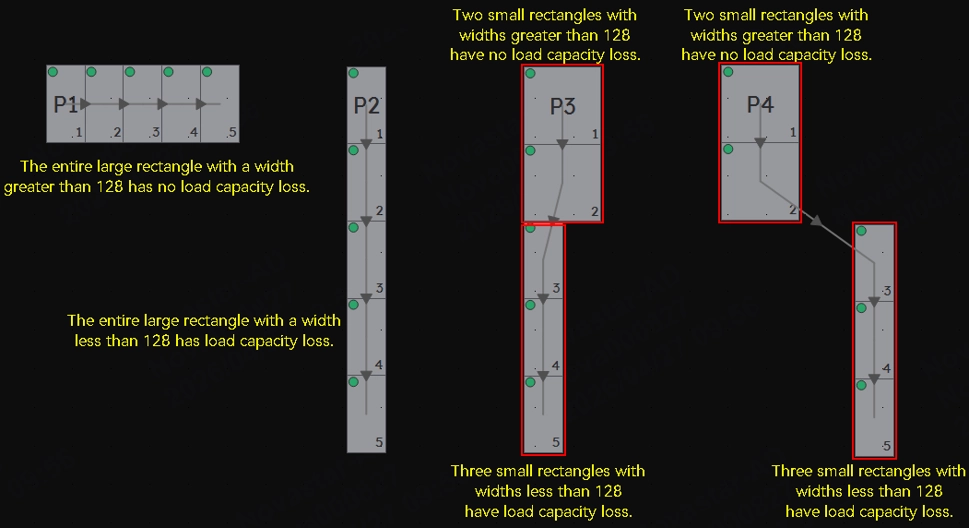
- To achieve the maximum load capacity, the width of each rectangular load area within a single Ethernet port must be at least 128 pixels. If the width of a rectangular load area within the Ethernet port is less than 128, the loss in capacity is calculated as (128 - width of the rectangular load area) × height of the rectangular load area. The total load capacity loss for the Ethernet port is the sum of the losses for all rectangular load areas within the port.
- When using the Ethernet port, pair it with a CAT5E cable for a maximum length of 100 meters.
¶ Hardware Shorts
¶ Download Links
- COEX Products File Downloads → COEX Page(The loading may take a few minutes)
We consistently enhance and refine the content of our Wiki articles.
If you find any mistakes or errors, please contact us.
Your continuous feedback and support will help us further improve our products and content.